Arctic Labyrinth
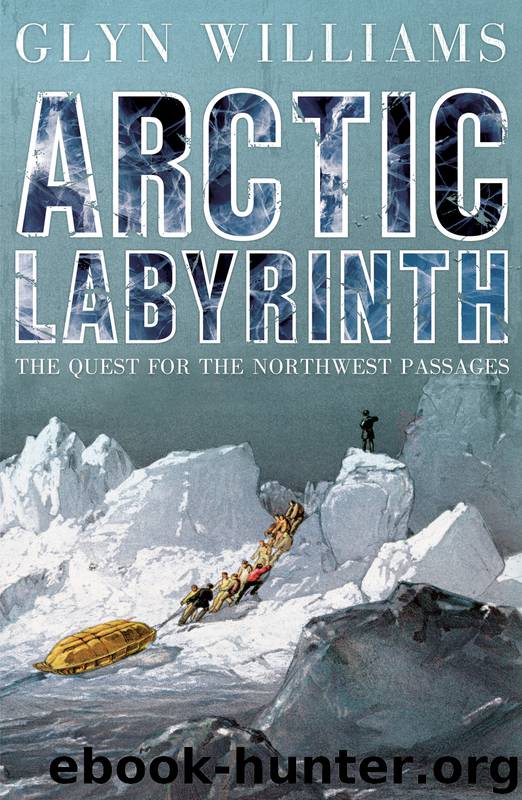
Author:Williams, Glyn
Language: eng
Format: epub
Publisher: Penguin Publishing
Published: 2009-09-18T16:00:00+00:00
As the sun went down nearly in the direction of the strait, we obtained from the mast-head a distinct and extensive view in that quarter, and it is impossible to conceive a more hopeless prospect than this now presented. One vast expanse of level solid ice occupied the whole extent of sea visible to the westward.
Parry had originally proposed that the Hecla should return to England, leaving the Fury and her crew to stay for a third winter, but given the surgeon’s report there were obvious risks arising from ‘a continued exposure to the same deprivations and confinements, the solitude of a single ship, and the painful monotony of a third winter to men whose health is precarious’. Among those most seriously affected was George Fife, ice-master of the Hecla, who died from scurvy on the return voyage. Realizing the hopelessness of pushing through Fury and Hecla Strait (which was not negotiated until the middle of the twentieth century, and then by powerful icebreakers), Parry decided to return home with both ships. It is possible that disputes between the officers hastened this decision, although the evidence for this is flimsy. Two months after Parry’s return Commander Douglas Clavering, just back from a voyage to Spitsbergen and East Greenland, wrote to a friend that Parry would not take any of his officers, except James Clark Ross, on a future voyage because of ‘quarrels, misbehaviour and insubordination’. In contradiction to this is a letter from Parry to his brother, Charles, in January 1824 in which he wrote warmly of several of his officers on the expedition, including Lyon, who in turn dedicated his book of the voyage to Parry, ‘whose friendship I am proud to possess’.
After a hazardous few weeks among the clashing ice floes of Foxe Basin and Hudson Strait, the ships reached the Shetland Islands in mid-October 1823. In his narrative of the voyage, published in 1824, Parry considered the implications of Franklin’s ill-fated first overland journey as well as the earlier Russian expedition commanded by Otto von Kotzebue that had sailed through Bering Strait in 1816. To Parry those explorations proved that the northern shore of the continent did not lie farther north than latitude 70°N or 71°N, and that although it was ‘occasionally’ blocked with ice, ships would also find open water. The problem was reaching that coast, at which point Parry looked back to the southward diversion on his voyage of 1819 into Prince Regent Inlet. He admitted that his experience at his farthest south in the inlet had not been encouraging, but pointed out that he had stayed in that spot only a few hours, and that the inlet was worth investigating again. With a fine flourish he concluded that ‘I never felt more sanguine of ultimate success in the enterprise in which I have been lately engaged than at the present moment.’ In private he may have been less optimistic. In a letter to his brother soon after his return he simply stated that ‘we
Download
This site does not store any files on its server. We only index and link to content provided by other sites. Please contact the content providers to delete copyright contents if any and email us, we'll remove relevant links or contents immediately.
| Africa | Americas |
| Arctic & Antarctica | Asia |
| Australia & Oceania | Europe |
| Middle East | Russia |
| United States | World |
| Ancient Civilizations | Military |
| Historical Study & Educational Resources |
Room 212 by Kate Stewart(5183)
The Crown by Robert Lacey(4861)
Endurance: Shackleton's Incredible Voyage by Alfred Lansing(4844)
The Iron Duke by The Iron Duke(4404)
The Rape of Nanking by Iris Chang(4255)
Joan of Arc by Mary Gordon(4155)
Say Nothing by Patrick Radden Keefe(4042)
Killing England by Bill O'Reilly(4041)
I'll Give You the Sun by Jandy Nelson(3496)
Shadow of Night by Deborah Harkness(3407)
Hitler's Monsters by Eric Kurlander(3384)
Mary, Queen of Scots, and the Murder of Lord Darnley by Alison Weir(3240)
Blood and Sand by Alex Von Tunzelmann(3238)
Eleanor & Park by Rainbow Rowell(3233)
Darkest Hour by Anthony McCarten(3161)
Margaret Thatcher: The Autobiography by Thatcher Margaret(3113)
Book of Life by Deborah Harkness(2983)
Red Famine: Stalin's War on Ukraine by Anne Applebaum(2968)
The One Memory of Flora Banks by Emily Barr(2898)
